

When three mighty Mughal emperors reigned over India and South Asia, they oversaw a golden age of creativity. Our expert, Georgina Bexon, explores the story behind the V&A South Kensington show that now celebrates the brilliant artists and makers at their courts.
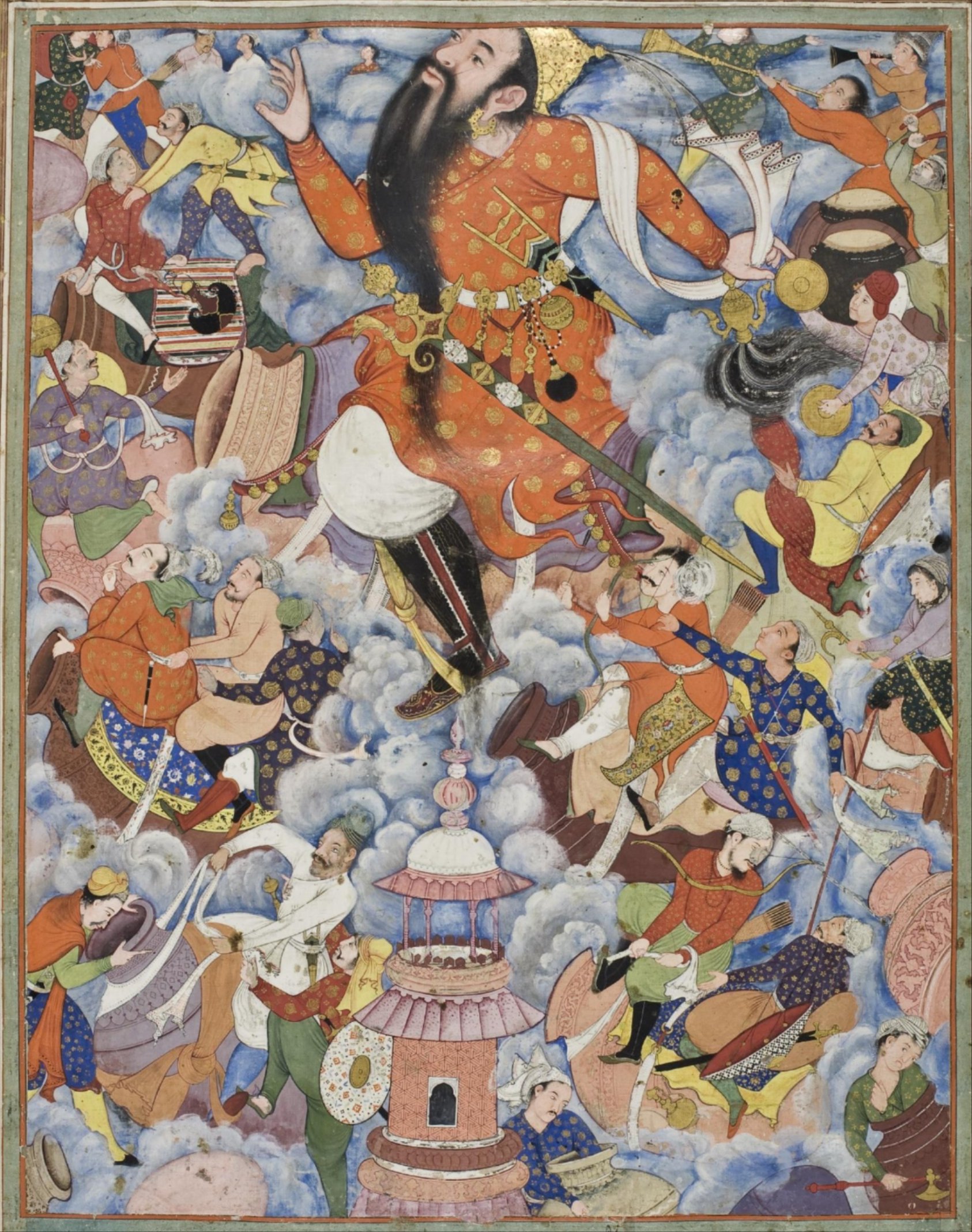
A precious artwork, The Giant Zumurrud Shah flees with his army by flying away on urns sent by sorcerers; a folio from the Hamza-Nama c.1562–77
Inscription in Shah Jahan’s palace in Delhi,
Persian verse by poet Amir Khusrow (1253–1325)
1. Treasure Troves
Until 5 May this year you can embark on an exploration of Mughal history, all while viewing astonishing artefacts connected to it. The exhibition The Great Mughals: Art, Architecture and Opulence is at V&A South Kensington and explores the creativity of the artisans in the workshops of the Great Mughal court in the period 1560–1660. All the pieces shown in this ‘Instant Expert’ can be seen in the show. From 1556–1658 the Mughal emperors Akbar, Jahangir and Shah Jahan ruled a vast empire (consisting of much of present-day India, Pakistan, Bangladesh and Afghanistan). It was the most powerful economic force in the world at the time. At the centre of this powerful Muslim dynasty was a sumptuous court and culture. Magnificent palaces were filled with exquisite paintings (such as that shown here), rich rugs and textiles, stunning jewellery, gem-encrusted artefacts, calligraphy, fine poetry and music. The Mughal emperors themselves were clothed in fabulous silks and adorned with sparkling gems. European visitors to the Mughal court during this golden age never failed to be awed by its wealth and splendour. Sir Thomas Roe, the first English ambassador to the court, wrote to Prince Charles (later Charles I) in England describing it as ‘the treasury of the world’.
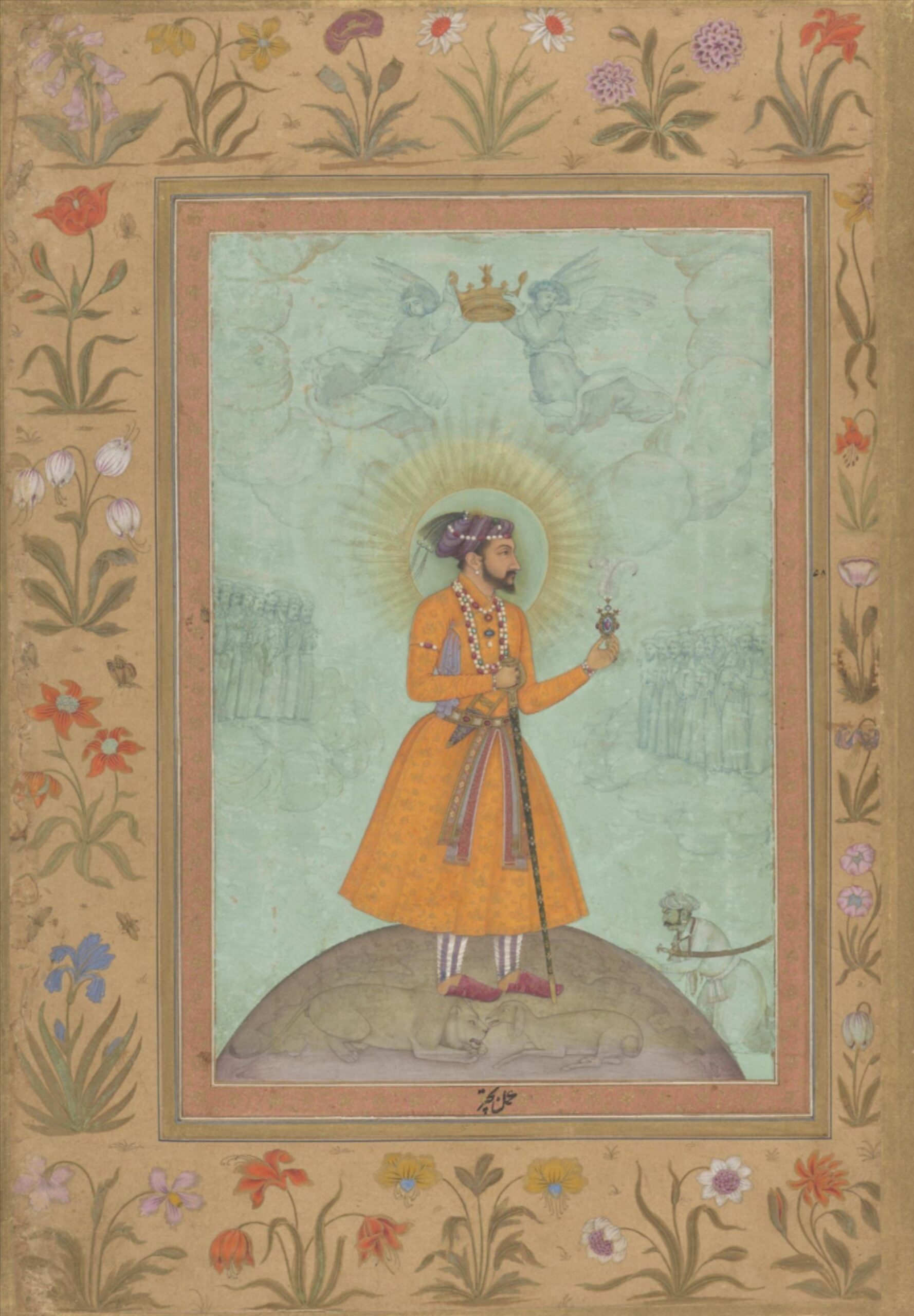
Shah Jahan as the King of the World by Bichitr, c.1628–30, a folio from the Minto Album
2. Signs of power
Of the many remarkable artefacts to grace the court was this superb miniature painting. Executed in opaque watercolour and gold on paper, it shows Emperor Shah Jahan admiring a sarpech – an ornament designed to be fixed to the front of a turban – comprising a jewel with a peacock feather attached.
Jewellery was an implicit form of court language. It imbued the emperor with status and authority. These were both communicated through the immense value of the pearls, rubies and emeralds around his neck, head, wrists, waist and dagger belt and, as a finishing touch, a glorious bazuband (armband) containing an impressive ruby.
Paintings such as these were produced by the imperial workshops; there the emperor assembled a team of Muslim and Hindu artists who worked peacefully alongside one another. The work in this miniature is meticulous. Each glowing detail has been painstakingly inscribed with a fine brush consisting of just a few squirrel hairs, while also using carefully mixed paints made from ground minerals combined with gum arabic. The results were then burnished with an agate stone to achieve a distinctive luminosity.
In 1617 Emperor Jahangir awarded Prince Khurram the name Shah Jahan, meaning ‘King of the World’, which he retained when he ascended the throne in 1628. This grand title was swiftly adopted by court artists as an artistic theme. In this painting Shah Jahan is shown literally astride a globe; at his feet a lion and sheep lie placidly together, signalling peace and harmony in his empire. This painting would have been bound into a muraqqa (album), along with pages of delicate calligraphy surrounded by graceful ornamentation.
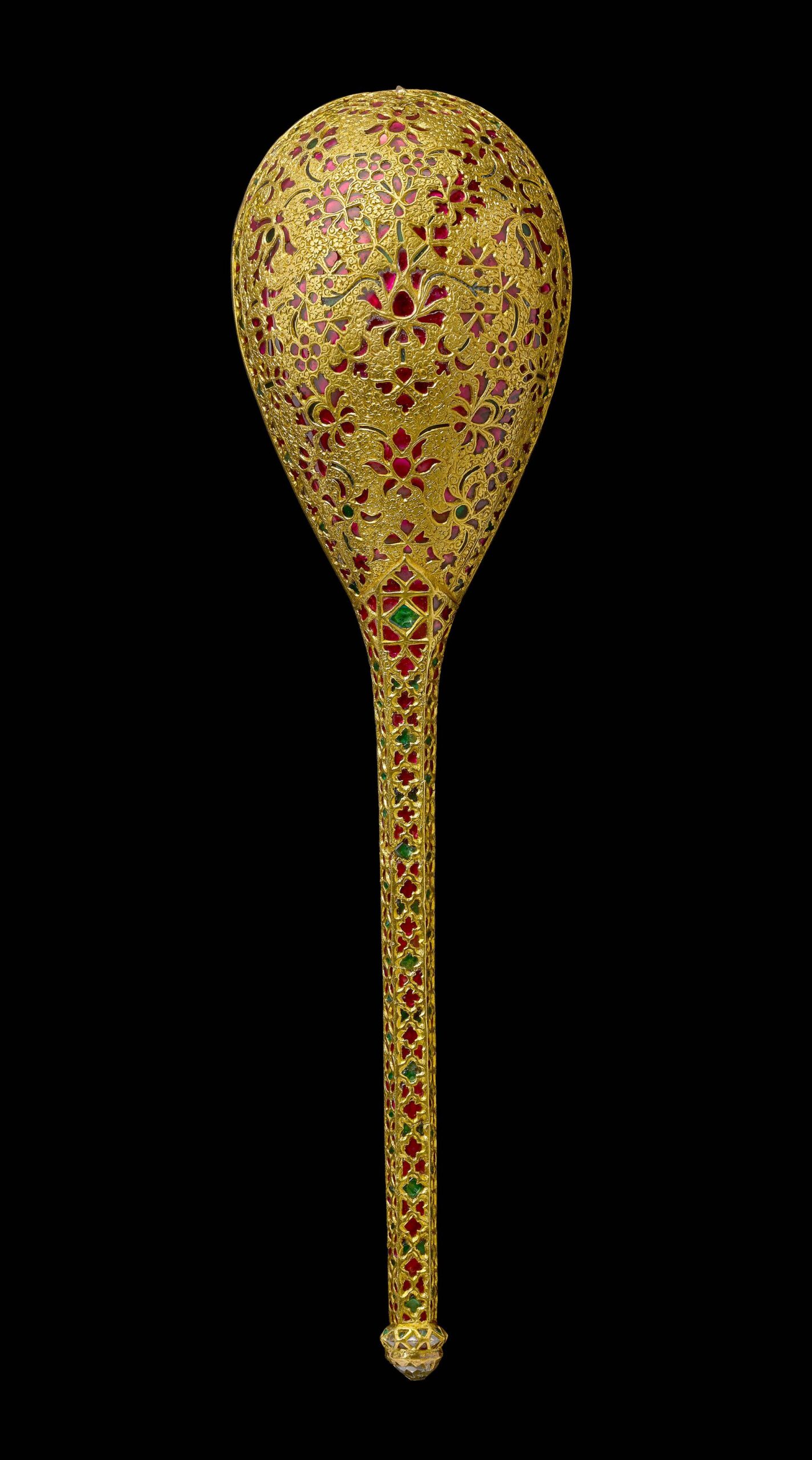
Ceremonial spoon, about 1600, gold set with diamonds, rubies and emeralds
3. A taste for the best
The Mughal emperors were educated, cultured and obsessed with beautiful objects. Exquisite jewels and ornaments enhanced the opulence of the court and acted as a form of power display, impressing courtiers, officials and particularly foreign visitors in a world where international diplomacy and trade were flourishing. Bejewelled objects, just like jewels, were part of the lavish performance of kingship. They featured everywhere, including at the table.
Developing Mughal tastes and demand for innovation meant artistic forms in the court took on a hybrid mode. An ornate Persian style was mixed with local creative flair, as with this elegant spoon. It was designed using the local Hindustani technique of setting slivers of rubies, emeralds and diamonds in a pure soft gold, known as kundan, with a distinctive delicate Persian scroll and flower design. The merging and exchange of different cultural traditions in the aesthetic of the court reflected the court and state infrastructure as a whole, for these three Mughal emperors exercised a large degree of religious tolerance. They married Hindu princesses and appointed Hindus as court officials, military commanders and provincial governors.
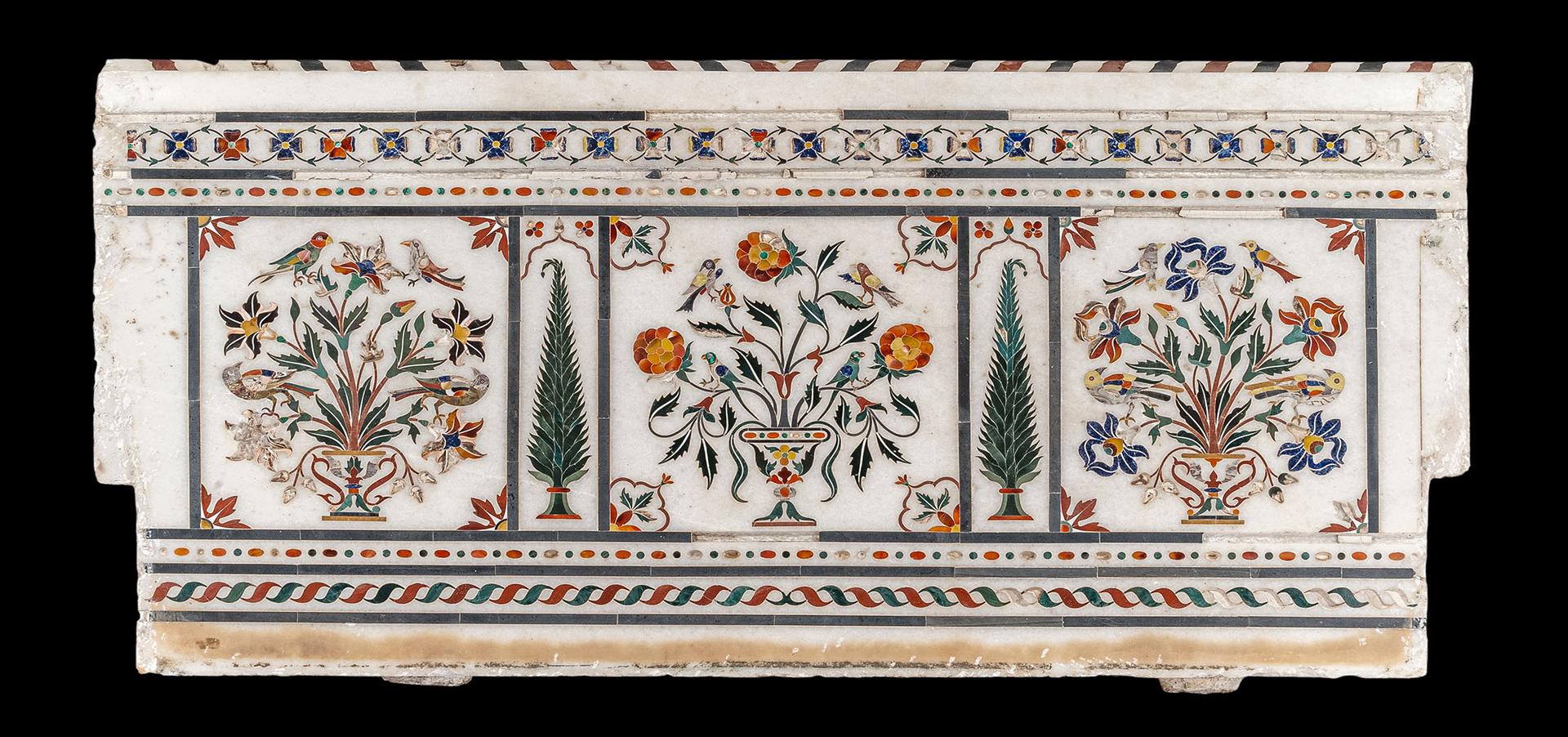
Inlaid marble balustrades, 17th century, on loan from The al-Sabah Collection, Dar al-Athar al-Islamiyyah
4. Marble and gems
The city of Agra, one of the Mughal capitals (others, at various times, were Lahore, Delhi and Shahjahanabad), developed as an important centre for the highly skilled craft of inlaying expensive white marble with coloured stones.
Craftsmen from the region and beyond were attracted to this artistic hub, and materials were shipped from all over Asia as part of growing Mughal trade networks. From the Punjab came jasper; jade and crystal from China; turquoise from Tibet; lapis lazuli from Afghanistan; sapphires from Sri Lanka; carnelian from Arabia; and garnets and diamonds from Bundelkhand, central India.
The spectacular technique of inlaying marble with precious stones was used in important forts and palaces and can still be seen in situ in India today. The designs were inventive, while adhering to traditional Islamic motifs: delicate depictions of flowers, trailing leaves and vines, birds, beautiful geometrical and arabesque patterns and calligraphic verses from the Koran all featured. The marble balustrade seen here is typical of this much-admired craft.
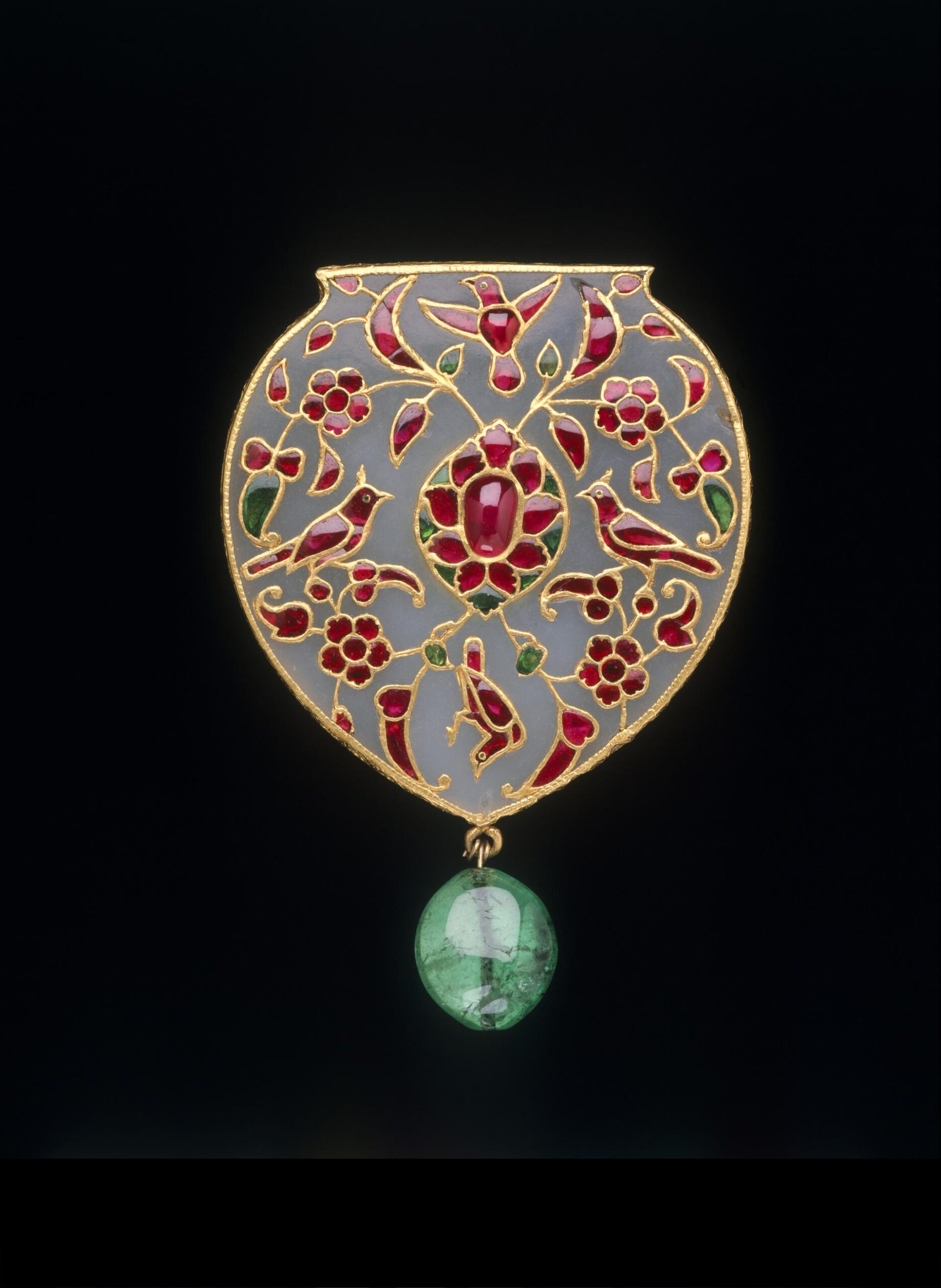
A pendant, c.1610–20, from the Mughal court workshops, made of nephrite jade set with rubies and emeralds in gold
5. Coffers of jewels
This stunning pendant is inscribed with a Koranic verse on the reverse, a common practice in the Mughal court and thought to enhance talismanic power. It may well have been made for Jahangir himself as it incorporates crested birds (hoopoes) into the design, a popular symbol of the Mughal emperors and associated with the wisdom of Suleyman (Solomon).
The emperors took pride in their understanding of fine jewels; they possessed detailed knowledge of the precious gemstones that were stored in the court treasury. The treasury grew ever larger over the reigns of the three men, overflowing with precious gems, pearls and gold. Jewels were frequently presented to them as gifts by diplomats and court officials, local administrators and army personnel, many hoping to buy advancement. Large amounts of jewellery and other precious items also entered the treasury by way of booty from military conquests and ‘peace’ treaties with neighbouring princely states. So the overflowing treasury signified not only the fabulous wealth of the dynasty but also its military might.
Coloured gemstones were particularly popular and were kept in the first tier of the court treasury. Diamonds, being colourless, only made it onto the second tier. Emeralds had a special allure and were known to the Mughal emperors as ‘tears of the moon’. There is a popular legend that Shah Jahan used emeralds to soothe his tired eyes after weeping for days following the death of his wife, Mumtaz Mahal.
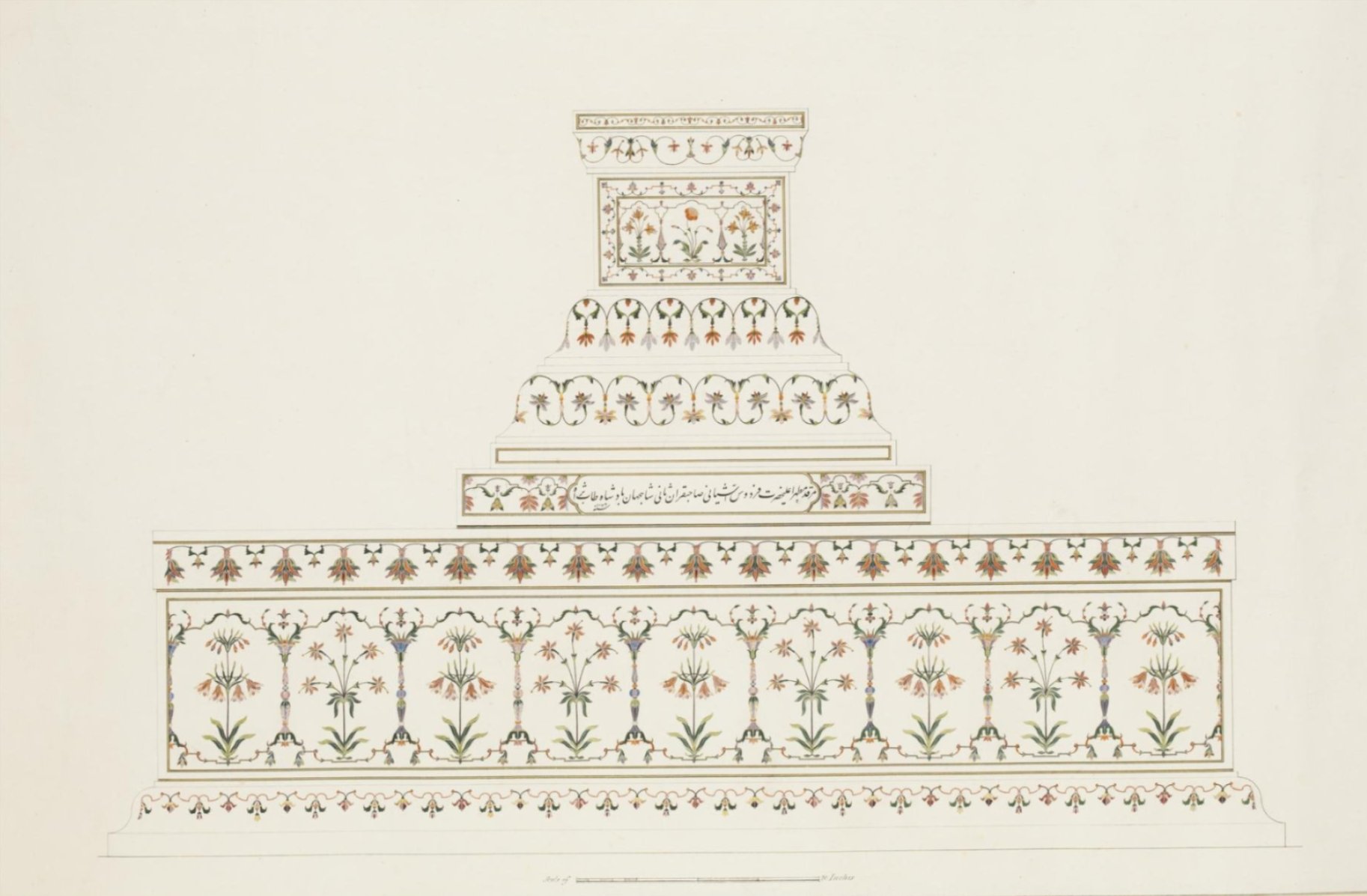
A drawing of the cenotaph of Shah Jahan in the Taj Mahal at Agra, 1782–93
6. Poetic designs
The emperors built ever more extraordinary palaces and forts throughout the golden age. It was under Shah Jahan, famously, that splendour reached its zenith when he built the Taj Mahal as a memorial to his wife, Mumtaz, when she died in 1631.
Situated on the Yamuna River near Agra, its dome and surrounding minarets were designed to express balance and harmony and, endearingly, it has been described as a ‘love poem in marble’. It was constructed using brick, which was then covered with smooth white marble and inlaid with gems. That marble was transported by some 10,000 elephants from Makrana, 200 miles away. Over 20,000 men came together to realise its build. They included stonecutters hailing from Balochistan, mosaicists from southern India, stone carvers from Bukhara and many more skilled artisans, sculptors, inlayers and calligraphers.
This drawing of the emperor’s cenotaph (which is placed beside Mumtaz’s cenotaph in the Taj Mahal, with their bodies buried on the level below) shows an intricately patterned Islamic design. It features vines and flowers to be created in marble inlaid with precious and semi-precious stones. The pair of cenotaphs are set in an eight-sided chamber ornamented with inlaid marble and lattice screens; it is a silent, bejewelled resting place.
Shah Jahan’s reign ended in 1658. He was followed by his son, Aurangzeb, who oversaw a gradual decline in Mughal power. With that came the beginning of the end of the production of beautiful art, jewels and ornaments. Court artists and craftsmen secured new patrons, often some distance from Delhi and Agra. Although many of the artistic skills and forms created under the Mughals survived in other princely courts as a memorial to this extraordinary dynasty, ‘the treasury of the world’ itself was over.
Georgina’s top tips
See
Top sites for Mughal art in the UK include:
- The Great Mughals: Art, Architecture and Opulence at V&A South Kensington, London until 5 May; while there take in, too, the Nehru Gallery
- The Sir Joseph Hotung Gallery, British Museum, London
- The Clive Museum, Powis Castle, Powys
- Examples of Indo-Saracenic architecture in the UK including Sezincote House, near Moreton-in-Marsh, Gloucestershire and Brighton Pavilion, East Sussex
Explore further afield
Among the many important Mughal sites (all UNESCO World Heritage Sites) to visit in South Asia are:
- Hamayun’s Tomb, Delhi: built in 1570, the first of the dynastic mausoleums
- Akbar’s Tomb, Agra: the magnificent tomb of the Mughal emperor Akbar, who died in 1605
- Jahangir’s Tomb, Lahore: tomb of the powerful ruler who died in 1627
- Jami Masjid, Delhi, built in 1656, one of the finest mosques in India, built by Shah Jahan
- The Red Fort, Delhi, 1648, a fortress-palace complex built by Shah Jahan